
Ford County Parole Versus Probation
Parole and mandatory supervised release, often shortened to MSR, follow an Illinois prison term. The Illinois Department of Corrections Parole Division supervises that person in the community. The Illinois Prisoner Review Board sets release conditions, conducts several kinds of hearings, and may grant final discharge. Ford County Probation, by contrast, supervises a sentence imposed by the circuit court. Probation can follow a Ford County Jail stay, but it is not release from IDOC and does not appear in the IDOC inmate search.
The first record should match the type of sentence. An IDOC result marked PAROLE is a state supervision record. A Ford County Judici docket showing probation is a court record. The Sheriff record remains necessary when the question is when someone physically left the jail.
| Point | Parole or MSR | Probation |
|---|---|---|
| What comes first | An IDOC prison term | A Ford County court order |
| Supervising agency | IDOC Parole Division | Ford County Probation |
| Public starting point | IDOC inmate search | Ford County Judici docket |
| Useful public markers | PAROLE status, Parole Date, parole district, Projected Discharge Date | Probation order, changes, violation, revocation, or discharge entries |
| End of supervision | Sentence completion or PRB final discharge | Court-recorded completion or discharge |
- Parole or MSR
- Community supervision after release from an IDOC prison term.
- Probation
- A community-based sentence ordered and controlled by the circuit court.
- Absconder
- A person alleged to have stopped reporting or complying with supervision.
- Final discharge
- The event that ends the remaining state supervision status.
Check Ford County Post-Release Supervision
Use identity details and the sentencing source, not a name alone. The IDOC inmate search covers people in state prison and on state parole. It does not act as a Ford County probation list. The Ford County Judici search is the local starting point for probation, using court code IL027015J.
- Match the full name, birth data, case number, or IDOC number before relying on a result.
- For state release, read the IDOC status, actual Parole Date, parole district, and Projected Discharge Date together.
- For probation, open the matching Ford County criminal case and locate the sentence, probation term, later modifications, or discharge.
- Contact the correct office for record-specific routing. Use IDOC statewide parole routing for parole and Ford County Probation for a local probation order.
- Check later docket or PRB entries if a warrant, violation, detention, or revocation may have changed the status.
- Ask the Sheriff for the discharge or transfer event when the physical Ford County Jail exit remains in question.
A projected discharge date is an estimate. It does not prove that parole has ended or that no later hold exists.
The full custody search and Sheriff records path for a person who left jail is available on the Ford County released inmates home page. That process complements supervision records rather than replacing them.
An official IDOC example record shows how parole status, the actual Parole Date, district, and Projected Discharge Date appear together.
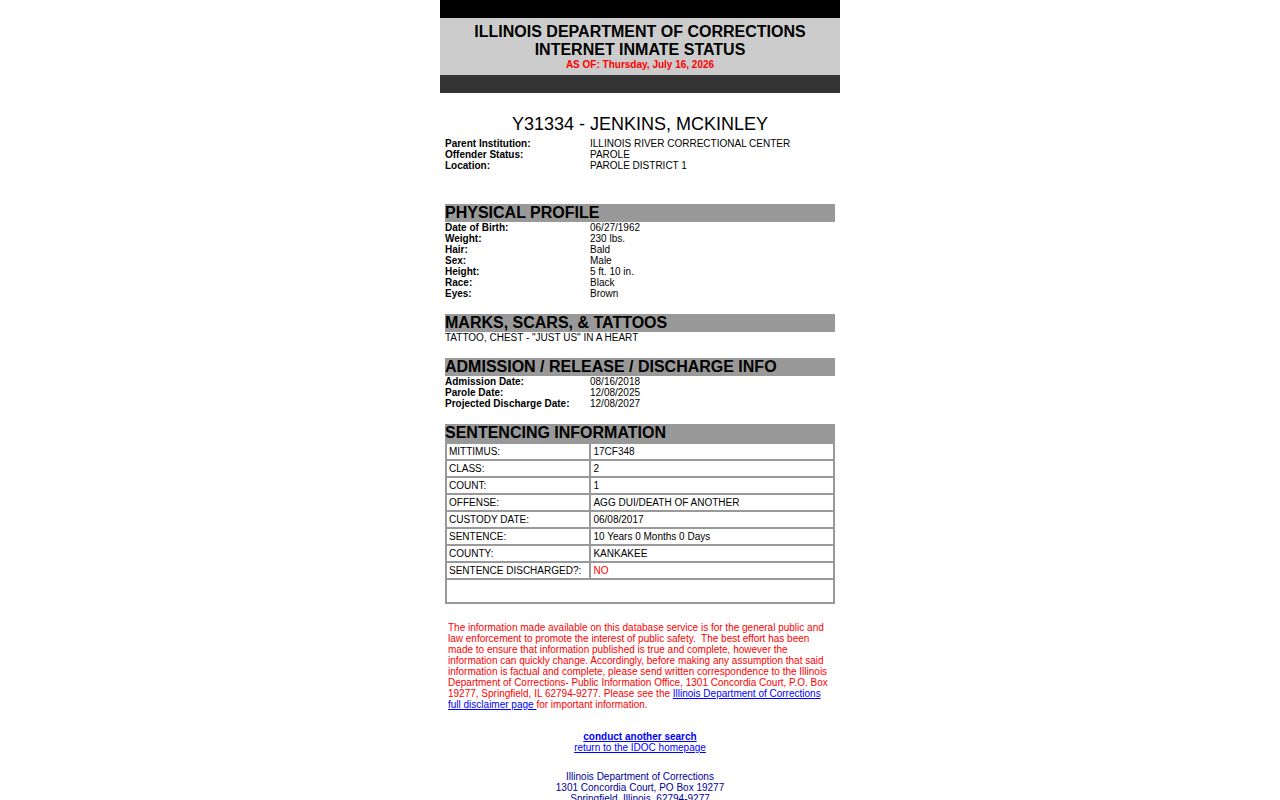
The example demonstrates why each labeled date must be read in context before deciding whether state supervision is active.
Identity matching matters most when names repeat. An IDOC number links the result to a state corrections file, while a Ford County case number links the probation order to the circuit court docket. A date in one system may describe sentencing, prison release, supervision discharge, or a later violation. Record the field label and the date viewed. Then compare the agency, case, and current status before treating two entries as the same event.
Ford County Probation Office Records
The Ford County Probation Office is the local contact for a probation sentence. Its page names Jennifer Harrison, CMO, and publishes both a travel-permit form and a community-service log. It does not publish a searchable probationer database or absconder list. A person-specific inquiry may clarify routing where disclosure is allowed, but the signed court order remains the source for the sentence itself.
Ford County Probation Office
200 W. State Street, Lower Level
Paxton, IL 60957
Phone: 217-379-9450
Fax: 217-379-9459
Hours: 8:30 a.m. to 4:30 p.m.
For parole, IDOC publishes statewide routing at 800-666-6744. Research did not establish a current official county-to-district address for Ford County, so that live statewide number is safer than an old local listing. Before prison release, an approved residence is required and release-plan questions route through the current facility’s Field Services.
These contacts answer different questions. Probation can explain a county supervision requirement. IDOC can route a state parole matter. Neither office substitutes for the Sheriff’s exact discharge or transfer timestamp.
The Circuit Clerk can provide the public order when Judici abbreviations do not resolve the terms. That office is at 200 W. State Street, Room 106, Paxton, and can be reached at 217-379-9420 during its published 8:30 a.m. to 4:30 p.m. hours. The clerk supplies the court file, while probation administers the local supervision ordered in it.
Ford County Violations and Revocation
Supervision conditions are person-specific. The filed order or PRB release document controls, not a general list. A violation allegation can lead to added conditions, a warrant, detention, or a formal revocation process. An absconder label means the person is alleged to have stopped complying or reporting. It does not mean the person was never released, and a missing name in a public tool is not proof of absconder status.
The PRB revocation process allows three broad outcomes. A panel may find a violation and return the person to supervision, with or without added conditions. It may find no violation and resume release after a plan is approved. It may revoke parole or MSR, after which IDOC recalculates time and a new release date. The Board posts separate revocation schedules and revocation results.
The official PRB revocation-results page is the source behind the posted outcome documents.
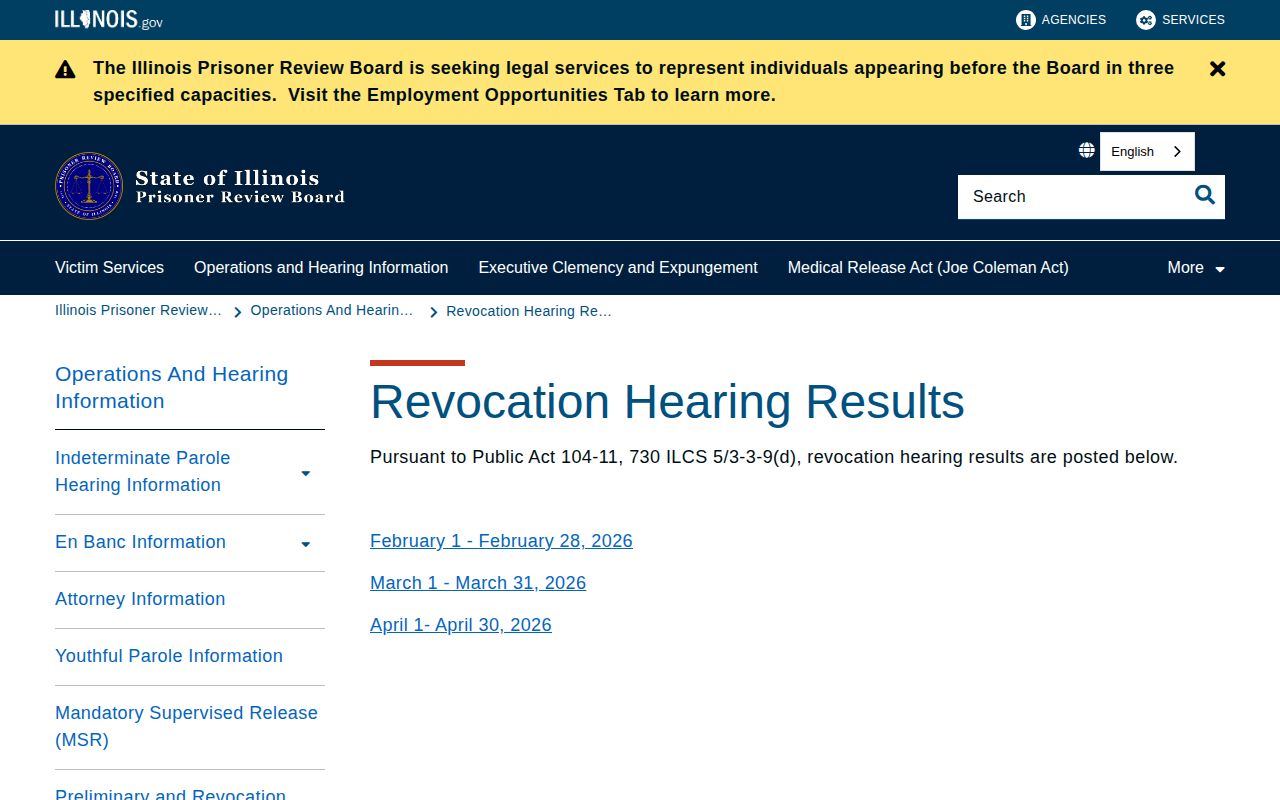
Use its dated result files with the current IDOC status, since an older docket does not establish today’s supervision state.
A person detained while a violation is decided is not currently released merely because an older Parole Date remains on the IDOC record. Check the current status, the Ford docket when a local warrant is involved, and the formal PRB outcome. Suspected unlawful conduct or a known location should be reported to the proper agency, not inferred from search results.
Note: Illinois VINE can report connected custody changes, but it is not a public parole-absconder directory or a permanent supervision archive.
When Ford County Supervision Ends
Release from a jail or prison starts the community phase in many cases. Discharge ends it. IDOC’s Projected Discharge Date forecasts the later end of the sentence and supervision framework, but it can change. The status and actual record must update before treating supervision as complete. A county probation term ends through the court record, so the final Ford County docket entry matters.
The PRB final-discharge process also permits early discharge from parole or MSR. The Board considers risk and needs, compliance, progress, case facts, public safety, participation, victim input, and a Parole Division recommendation. A favorable decision ends state supervision. It does not change the earlier prison release date or erase the underlying court record.
Completed IDOC sentences may disappear from the public inmate search. When that happens, an archived record inquiry should include the full name, birth date, approximate admission year, and useful facility, county, or date details. A blank current result is not enough to claim there was no parole or final discharge.
Ford County Work Release Status
Ford County’s monthly official reports include recurring work-release revenue. That evidence documents a local work-release operation during the reporting periods. It does not publish who qualified, when daily movement occurred, what schedule applied, or when final discharge took place. Work release permits authorized movement during custody. It is not the same event as full release from Ford County Jail.
For a named person, compare three sources. The Judici case can show the controlling order. Ford County Probation may explain a related supervision requirement within disclosure limits. The Sheriff’s custody record can identify the actual discharge or transfer event. The May 2025 county report supports the existence of revenue, but its aggregate line cannot establish an individual schedule or release.
That distinction matters because a person may leave the building for authorized work and still remain in legal custody. Only the record tied to the booking and court order resolves the status.
Ford County Parole Hearing Records
The Illinois Prisoner Review Board conducts several proceedings that answer different questions. Traditional indeterminate parole hearings mainly concern old-law sentences for crimes before 1978. Modern determinate terms generally reach release through sentence calculation, while PRB sets conditions and handles revocation. Youthful parole and medical release follow separate rules.
For an indeterminate case, the PRB hearing information says eligibility begins after IDOC calculates the minimum. A denied case returns in one to five years, with a separate vote able to set the next review two to five years later. The full or majority Board meets en banc each month. Use the yearly schedule landing page because the calendar changes. Current results and the historical past-paroles registry should be date-checked, since the results page can lag the meeting calendar.
730 ILCS 5/3-3-3 governs traditional eligibility. Section 5/5-4.5-115 governs youthful parole and contains multiple effective Public Act versions. The law and sentence date must be checked together. No hearing calendar should be used as a substitute for a current IDOC custody status.