
Ford County Projected Release Meaning
For an IDOC prisoner, the public record’s exact estimate is “Projected Parole Date.” It marks an expected prison-to-community-supervision transition. “Projected Discharge Date” refers to the later expected end of the sentence and supervision structure. An actual “Parole Date” or “Last Paroled Date” records an event that occurred. Those terms should not be collapsed into one date.
A Ford County Jail record works differently. A pretrial detainee has not received a final jail sentence and may have no calculable exit date. Bond, dismissal, plea, sentencing, another hold, or transfer can change custody. A future court date is not a release date. For a sentenced county-jail person, the commitment order, custody credit, statutory allowance, exclusions, and holds control the calculation.
Find Ford County Projected Dates
First identify the custodian. Ford County Jail, IDOC, another county, and a federal agency keep different records. Use the number and case details tied to that source. A county case number cannot replace an IDOC number, and an IDOC estimate does not calculate a Ford jail sentence.
- Ask whether the person is pretrial, serving a Ford County jail term, or serving an IDOC sentence.
- For a state prisoner, open the IDOC offender search and match the name, date of birth, and IDOC number.
- Record current status, custody location, Projected Parole Date, Projected Discharge Date, and any actual Parole Date.
- For a Ford jail term, obtain the sentencing or commitment order from the Ford County Circuit Clerk.
- Ask the Sheriff for the jail calculation, credit applied, exclusions, and any active holds.
- Date-stamp the result and check again near the estimate.
The Ford County released inmate search helps locate the right system. A VINELink Check can supply notice of a later event, but it does not compute the date.
IDOC Ford County Release Fields
The state search displays corrections information, not a county-jail release ledger. A strong match uses the person’s IDOC number and identity details. Read all date fields together so a projected parole transition is not mistaken for final discharge.
| IDOC field | Meaning |
|---|---|
| Status | Shows whether the person is in custody, on parole, or in another displayed state. |
| Projected Parole Date | Current estimate for prison exit to supervision. |
| Parole Date | Actual recorded transition to parole or mandatory supervised release. |
| Last Paroled Date | Prior parole event when shown. |
| Projected Discharge Date | Estimate for the later end of the sentence and supervision. |
| Custody location | Identifies the current state corrections placement or parole district. |
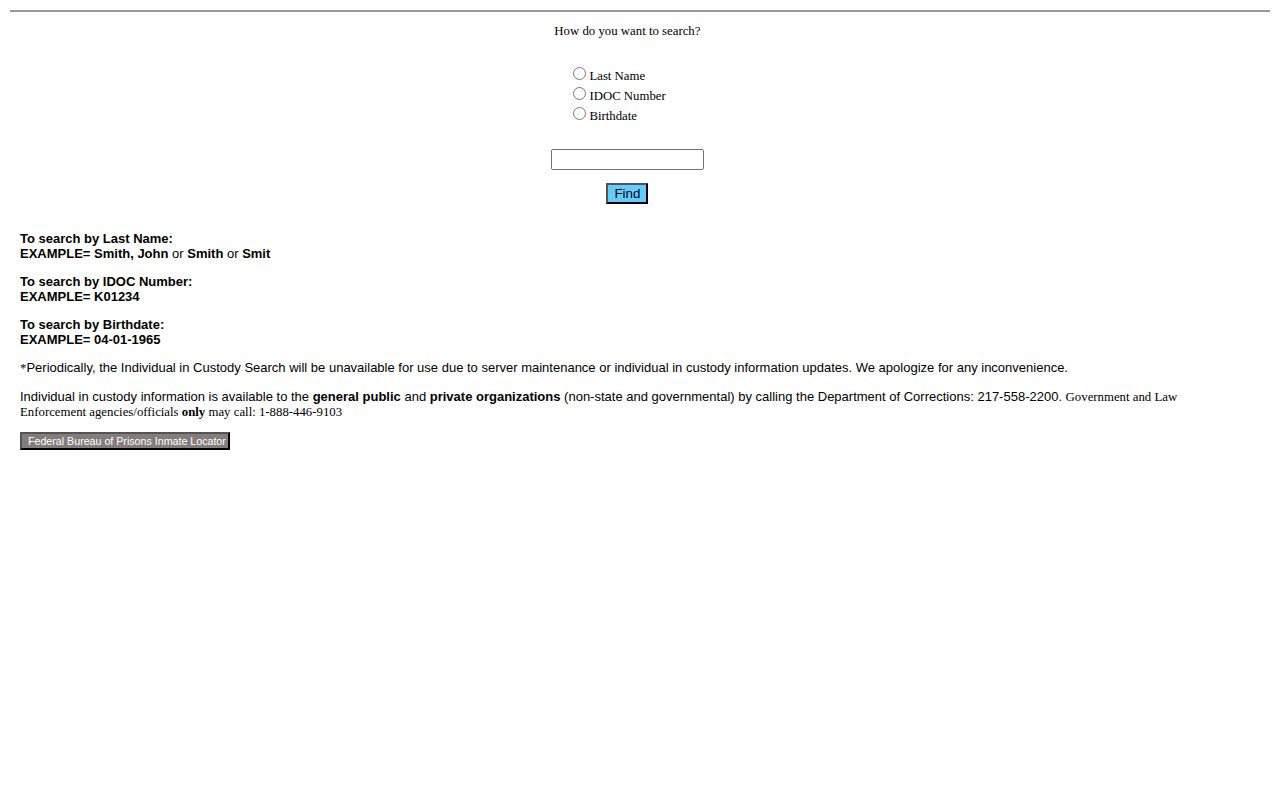
The official IDOC search form shows the fields used to begin a state lookup. The image below depicts that entry point.
IDOC public results generally disappear after final discharge. A missing result may therefore require an archived-record request rather than a claim that no corrections history exists.
Illinois IDOC Sentence Credits
730 ILCS 5/3-6-3 makes IDOC credit depend on the offense, offense date, sentence, and eligibility. The system cannot be reduced to “everyone serves half” or “every violent offense is 85 percent.” The statutory offense lists and amendments control.
| Common baseline | General statutory treatment |
|---|---|
| 100 percent | First-degree murder and terrorism provisions can require the entire term. |
| About 85 percent | Enumerated violent, sexual, firearm, and bodily-harm provisions allow no more than 4.5 credit days per month. |
| About 75 percent | Listed serious drug offenses allow no more than 7.5 credit days per month. |
| About 50 percent | Other eligible offenses can receive one credit day for each sentence day. |
These are baselines, not a person-specific calculator. Paragraph (4.7) permits added credit in restricted cases while preserving stated floors. Only an updated IDOC calculation can apply the right version of the law to the actual conviction and sentence.
IDOC Earned Credit Limits
Discretionary earned credit under subsection (a)(3) can reach up to 180 days for a term under five years and up to 365 days for a term of five years or more. The Director or designee controls selection. An assessment and eligibility finding are required, and ordinarily at least 60 days must be served, or as close to that point as the sentence permits. Eligibility does not create a right to an award.
Program credit can award a day for a qualifying full-time program day, subject to exclusions. A qualifying pretrial county program of 60 days or more can be included at sentencing. Credit may be earned, revoked, restored, or recalculated, which is why the displayed estimate can move.
The statute also contains an early-release notice process for certain discretionary credit cases. The historic IDOC early-release database reflects named program categories and older exits. It is not a current Ford County jail release feed and should not be used as one.
Ford County Jail Good Time
730 ILCS 130/3 governs eligible fixed county-jail terms begun after January 1, 1987. It provides one day of good-behavior allowance for each day served and one day for each eligible presentence county-jail day. Allowance days reduce confinement. A fractional day counts only when it exceeds 12 hours.
The county rule has exclusions. They include physical harm inflicted in the offense, reductions below a mandatory minimum, county impact incarceration, specified sexual offenses, and stated probation, conditional-discharge, or civil-contempt situations. Periodic imprisonment receives the allowance only when the sentencing judge authorizes it.
This one-for-one framework can resemble half time for an eligible fixed county term. Only the court and Sheriff can apply it to a real case. It cannot be used to reverse-engineer an IDOC Projected Parole Date.
Two Ford County Credit Systems
Illinois uses separate time-credit systems for the two common Ford County situations. A fixed county-jail term may fall under the county allowance statute. An IDOC sentence uses offense-specific 100, 85, 75, or 50 percent baselines plus any credits that the corrections statute permits. The place of confinement alone is not enough. The commitment and sentence identify which system applies.
| Question | County jail term | IDOC term |
|---|---|---|
| Primary record | Court commitment and Sheriff calculation | IDOC sentence calculation |
| Main statute | 730 ILCS 130/3 | 730 ILCS 5/3-6-3 |
| Public date field | No Ford public projected-date feed | Projected Parole Date |
| Who confirms | Ford Sheriff and Circuit Clerk | IDOC |
No official Ford County policy or Illinois custody statute found in the research creates a blanket Friday release when an end date falls on a weekend or holiday. Ask how the specific commitment was calculated.
Why Ford County Dates Change
A projected date is a live calculation. Compare the displayed estimate with its check date and the current custody record.
| Change factor | Possible effect |
|---|---|
| Credit award, loss, or restoration | Moves the estimate as IDOC or the jail updates earned time. |
| Corrected mittimus | A court correction changes the legal commitment. A mittimus is the written custody order. |
| Presentence credit | Added or corrected prior custody time changes the remaining term. |
| Concurrent or consecutive sentences | Terms may overlap or run one after another. |
| Detainer or new hold | Prevents community release even when one term reaches its date. |
| Parole or MSR violation | Can return a released person to custody and trigger recalculation. |
| Release-plan approval | May affect the timing of the transition to supervision. |
A new sentence, amended order, or receiving-agency hold can also change the path. Request the updated calculation rather than applying a general percentage to the original sentence.
Confirm Ford County Actual Release
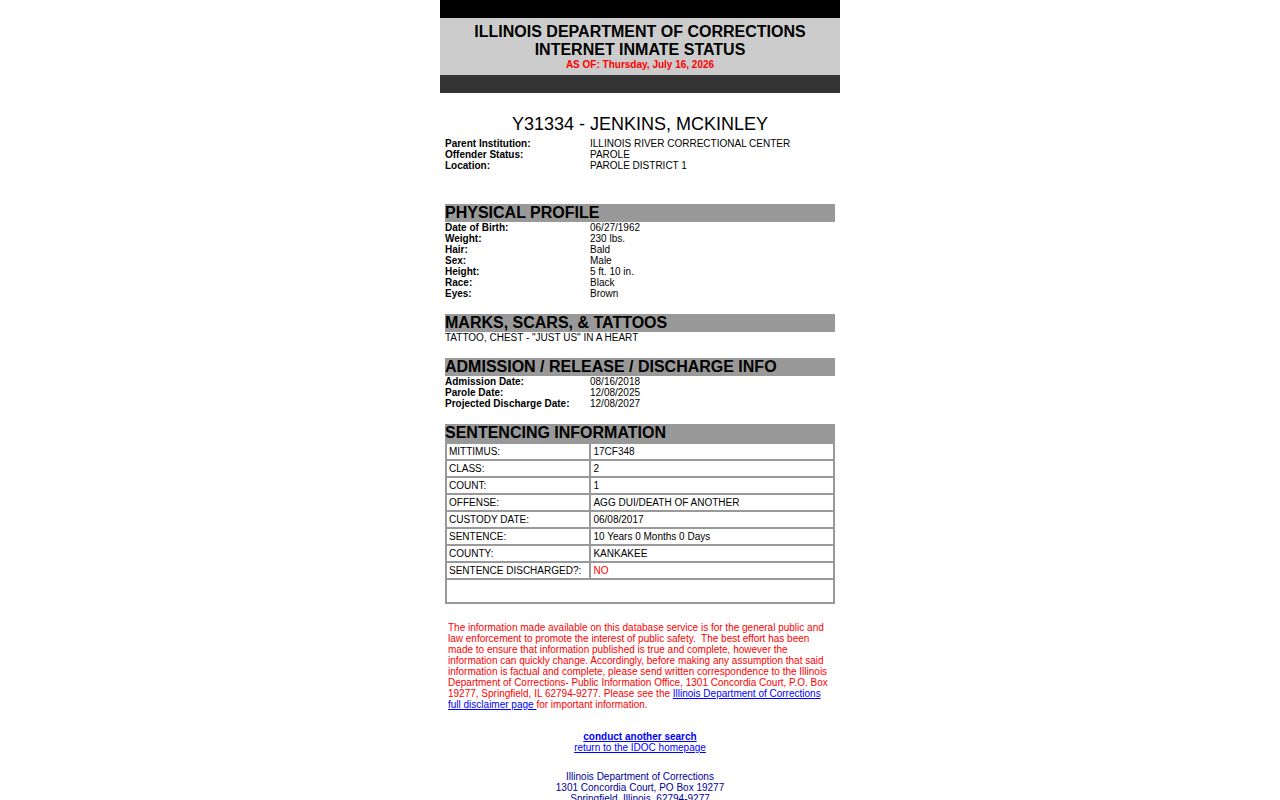
Near the projected date, check the same official system again. For IDOC, record status, Parole Date, and custody location. An official example result can show PAROLE status, a parole date, parole district, and projected discharge date together.
The official IDOC parole example illustrates those distinct fields. The image below shows why the actual parole event and later discharge estimate must be read separately.
For Ford County Jail, ask the Sheriff for the discharge or transfer time, code, authority, destination, and hold notation. Compare it with the Ford County Judici docket. A VINE alert can corroborate a connected event, but the originating office confirms it.
After the expected day passes, replace the estimate with the actual event when the record supplies one. If release did not occur, ask whether credit changed, a hold intervened, a court order was corrected, or a release plan remained unresolved. This follow-up prevents an old projected date from being treated as proof that the person left custody.
Date-stamp each IDOC result and each Sheriff response. A later custody location can reflect transfer rather than community release, while a parole district identifies supervision rather than a prison. When identity fields do not form a strong match, do not borrow a date from a similar name. Request the updated calculation using the correct IDOC number, booking number, or Ford County case number.